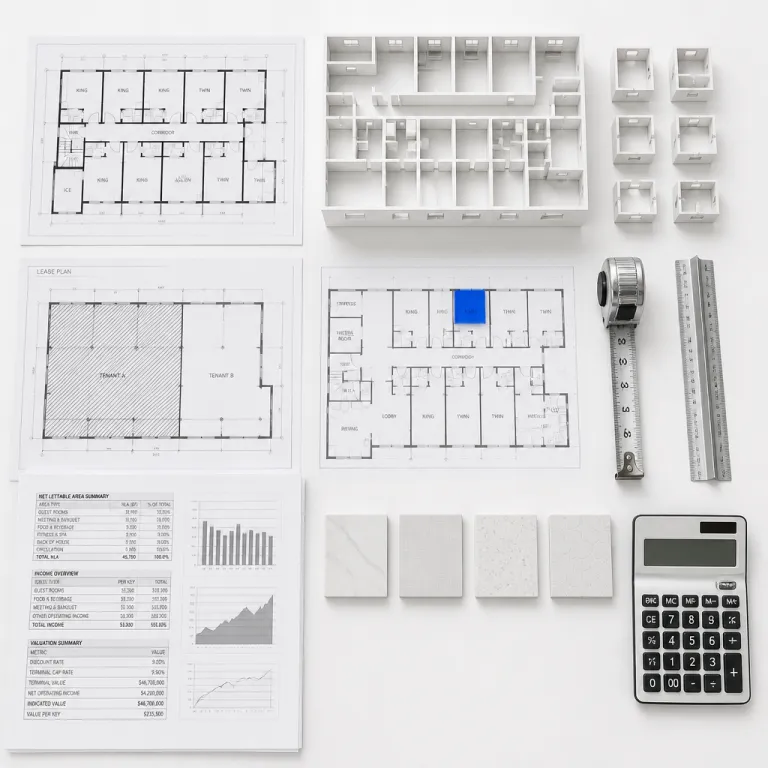
Why net lettable area is the silent driver of hotel valuations
For hotel investors, the net lettable area is no longer a technical footnote. It has become a primary lens through which the value of every square metre of floor space is judged, especially in mixed use hospitality buildings. When the area net of non revenue spaces is miscalculated, entire valuation models for a property can drift off course.
Net lettable area, often abbreviated as NLA, represents the internal usable floor area that can be leased to tenants and branded operators. In commercial hotel real estate, this lettable area excludes lifts, stairwells, structural walls and most common areas, but it includes internal finished surfaces that generate rent or management fees. The distinction between net lettable and gross lettable metrics is critical when lenders stress test debt yields and when funds benchmark assets across markets.
Property owners, asset managers and banks rely on a consistent method of measurement to compare buildings and areas across portfolios. In Australia, the Property Council of Australia, often referred to as the Property Council, has become a reference point for measurement conventions that define what is included in NLA and what remains in gross lettable area or GLA. Its Method of Measurement for Commercial Office Buildings (2019) is written for office assets rather than hotels, but many institutional investors adapt its principles when they commission an NLA survey for hospitality properties. When a council in Australia or another jurisdiction updates its guidelines, every area survey and every NLA survey for hotel properties must be recalibrated to protect valuation credibility.
From floor plan to cash flow: translating NLA into hotel income
On a hotel floor plan, the difference between floor area and net lettable area looks subtle but the financial impact is substantial. Usable floor space that qualifies as area NLA can be priced, leased and securitised, while circulation corridors and other common areas remain cost centres. For directeurs financiers, the art lies in aligning the lettable areas with the most profitable mix of rooms, retail and ancillary commercial spaces.
Net lettable area in a hotel building typically includes guest rooms, suites, meeting rooms, co working zones and some back of house spaces leased to third party tenants. It excludes lobbies, main reception, most service shafts, fire hose cupboards and many vertical penetrations, even though these areas are essential to operations. When a property combines hotel floors with external restaurants or offices, the GLA–NLA relationship must be mapped carefully so that each lease reflects the correct proportion of lettable and non lettable space.
Investors increasingly link NLA efficiency to ESG aligned repositioning strategies and to the resilience of branded platforms. A detailed area survey can reveal underperforming floor space that could be converted into higher yielding lettable area, especially in urban hotels with strong footfall. For example, a 2022 internal review by a major Asia–Pacific hotel REIT found that converting oversized storage rooms on two floors into co working suites increased the property’s NLA by roughly 3 % and lifted annual net operating income by more than 4 %, illustrating how targeted NLA optimisation can materially enhance returns.
Measurement standards, PCA guidance and the risk of valuation drift
Hotel valuations built on inconsistent area measurement are exposed to disputes, covenant breaches and mispriced transactions. The Property Council of Australia, often shortened to PCA in industry discussions, has codified how net lettable area should be measured in commercial properties, with a primary focus on office buildings rather than hotels. Its guidance clarifies which internal finished surfaces count towards NLA and which remain in gross lettable area calculations, and many valuers use these rules as a benchmark when assessing mixed use hotel assets.
According to the Property Council of Australia’s Method of Measurement for Commercial Office Buildings (2019, Section 3, pp. 6–7), “Net Lettable Area (NLA) is the total usable floor space within a property available for lease, excluding common areas.” This definition means that common areas such as lobbies, shared restrooms and most vertical circulation are not included in the area NLA used for rent calculations. For hotel investors, aligning every NLA survey with a clearly documented method of measurement, such as the PCA office standard adapted for hospitality or an equivalent local code, is essential when comparing assets across cities and when negotiating with lenders that rely on PCA style standards.
Interest rate volatility has pushed valuers to scrutinise every square metre of floor space and every lease assumption. Asset managers now pair precise NLA and GLA metrics with updated capitalisation rates, as discussed in analyses of how hotel appraisers adjust for the new interest rate floor. When the method of measurement for net lettable area is robust and transparently disclosed in valuation reports, the dialogue between banks, funds and property owners becomes more transparent and less exposed to disputes over what is or is not included.
Operational leases, tenants and the monetisation of every square metre
Hotel income statements increasingly depend on how net lettable area is allocated between operators and third party tenants. A single property can host branded hotel operations, signature restaurants, co working tenants and retail leases, each with different expectations about floor area and common areas. The way these leases define lettable area and GLA–NLA boundaries determines both base rent and variable turnover components.
For a restaurant tenant on the ground floor, the lease will usually reference the NLA survey to define the exact floor space included in the rent. Internal finished walls, columns and even fire hose cupboards may or may not be counted, depending on the PCA style method of measurement adopted by the Property Council of Australia or local regulator. When multiple tenants share back of house corridors or technical rooms, the allocation of these common areas must be clearly described so that each tenant understands which areas are lettable and which are shared.
Asset managers who negotiate leases across several buildings often request quote comparisons from surveyors to standardise area survey practices. They want assurance that every lettable area in their portfolio has been measured using the same method of measurement, whether the property is in Property Council of Australia jurisdictions or elsewhere. This consistency allows them to benchmark tenants’ occupancy costs per square metre of net lettable area and to identify where lease terms can be tightened without damaging long term relationships.
Digital surveys, fintech travel and the next generation of NLA data
Digital measurement tools are transforming how hotel investors capture and use net lettable area data. Laser scanning, drone imagery and Building Information Modelling now feed directly into NLA survey outputs, reducing disputes about floor area and internal finished boundaries. For fintech travel platforms that underwrite revenue based financing, this level of precision in area measurement is rapidly becoming a prerequisite.
When a hotel building is scanned, the resulting digital floor plan can distinguish between lettable areas, common areas and technical spaces with centimetre level accuracy. These datasets allow asset managers to simulate alternative layouts, reallocating floor space from low yielding storage to high yielding commercial uses that expand the net lettable footprint. In mixed use properties, the integration of GLA and NLA layers helps investors understand how much of the total building area is truly income producing.
Fintech lenders and banks are starting to embed NLA metrics into automated underwriting APIs that respond instantly when owners request quote offers. A property with a high ratio of net lettable area to gross lettable area will typically secure better terms, because its floor space is more efficiently monetised. For hotel groups, the strategic use of digital area survey data becomes a competitive advantage when negotiating management agreements, leases and green financing linked to space efficiency KPIs.
Governance, disputes and aligning stakeholders around NLA
Misunderstandings about net lettable area often surface during rent reviews, refinancing or asset sales. Property owners, tenants and real estate agents may each hold different interpretations of what is included in the lettable area, especially in complex hotel buildings. Without a shared reference such as PCA guidance or a recent NLA survey, these disagreements can escalate into costly disputes.
Robust governance starts with clear documentation of every area survey, including the method of measurement used, the date of the survey and the surveyor’s credentials. Lease clauses should reference the specific NLA survey and clarify how changes to floor space, such as new internal finished partitions or reconfigured common areas, will be treated. When tenants understand how their floor area has been calculated, they are more likely to accept rent adjustments tied to net lettable metrics.
For cross border investors, aligning governance across portfolios means adopting a consistent framework for GLA–NLA definitions, even when local property council standards differ. Asset managers should maintain a central register of building areas, floor by floor, showing which spaces are lettable, which are common and which are excluded from both NLA and GLA. This discipline not only supports fair lease negotiations but also enhances the credibility of valuations presented to banks, funds and rating agencies.
Key statistics on net lettable area in hotel assets
- The average NLA efficiency ratio in commercial properties is reported at approximately 80 %, according to the Property Council of Australia’s Method of Measurement for Commercial Office Buildings (2019, p. 5), meaning that roughly four fifths of a typical building’s floor area is income producing.
- In many urban hotels, converting just 5 % of non revenue floor space into net lettable area can increase annual net operating income by several percentage points, materially affecting capitalisation based valuations; for example, a 20,000 m² hotel with an additional 1,000 m² of NLA leased at AUD 700 per m² could add AUD 700,000 to annual NOI, which at a 6 % capitalisation rate implies around AUD 11.7 million of incremental capital value.
- Standardised NLA measurement practices have been widely adopted across institutional grade real estate portfolios, improving comparability of hotel assets and reducing disputes between landlords and tenants.
- Digital NLA survey tools have shortened the time required to measure complex mixed use buildings from weeks to days, accelerating refinancing and transaction processes for hotel investors.
Frequently asked questions about net lettable area in hotels
What is included in net lettable area for a hotel property ?
In hotel real estate, net lettable area generally includes internal finished spaces that can be leased or operated for revenue, such as guest rooms, meeting rooms, leased restaurants and some back of house areas. It excludes most common areas like lobbies, shared restrooms, main corridors and vertical circulation. The exact inclusions depend on the applicable Property Council or local standard and should be confirmed in the NLA survey.
Why is NLA so important for hotel valuations and financing ?
NLA determines how much of a hotel building’s floor space can generate rent or management fees, which directly influences net operating income. Valuers, banks and funds use net lettable area to calculate key metrics such as rent per square metre and capital value per square metre. A higher NLA efficiency ratio usually supports stronger valuations and more attractive financing terms.
How is net lettable area calculated in practice ?
Surveyors measure the internal usable space within a property, following standards such as those issued by the Property Council of Australia. They map the floor plan, identify internal finished boundaries and exclude common areas, structural walls and most service shafts from the NLA. The result is an audited figure for net lettable area that can be used consistently in leases, valuations and financing documents.
How do NLA and GLA differ in mixed use hotel buildings ?
Gross lettable area, or GLA, usually represents the total area of a building that could theoretically be leased, including some shared or ancillary spaces. Net lettable area is narrower and focuses on the internal usable floor space that is directly attributable to a specific tenant or operator. In mixed use hotels, investors track both GLA and NLA to understand overall density while pricing leases and management agreements on the more precise NLA figure.
How should hotel owners handle disputes about NLA with tenants ?
When disputes arise, owners should refer to the original NLA survey, the method of measurement standard cited in the lease and any subsequent area survey updates. Commissioning an independent surveyor to re measure the floor area using recognised Property Council or equivalent standards often resolves disagreements. Clear communication about what is included in net lettable area and how common areas are treated helps maintain long term tenant relationships.
References
- Property Council of Australia – Method of Measurement for Commercial Office Buildings, 2019
- Royal Institution of Chartered Surveyors – professional standards for property measurement
- Urban Land Institute – research on hotel and mixed use asset performance
