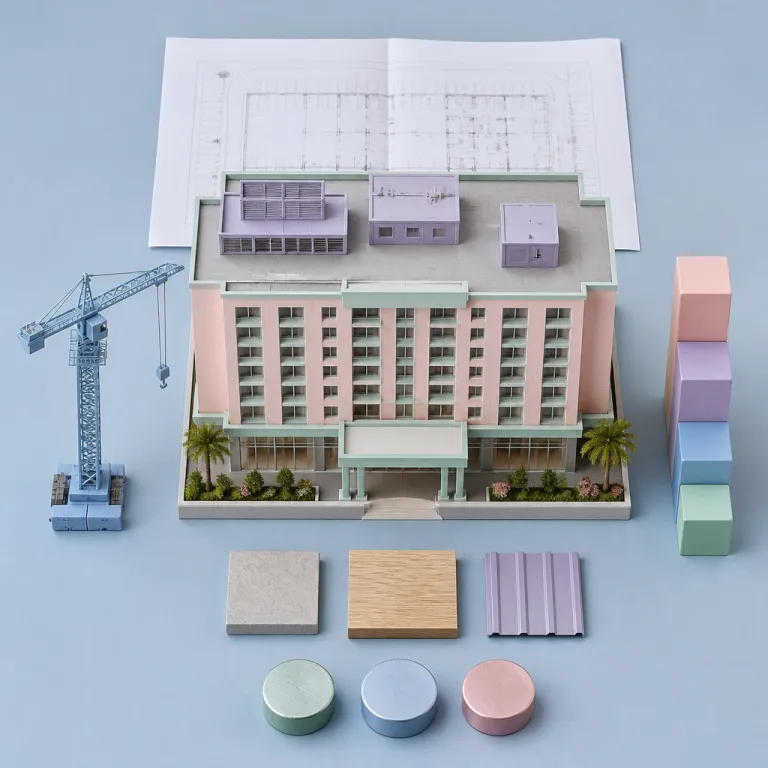
Why hotel construction cost per room 2026 is now the core underwriting variable
Hotel construction cost per room 2026 has moved from a back-of-the-envelope assumption to the central line in every feasibility model. For directeurs financiers and asset managers, the way this per key budget shapes debt sizing, equity cheques, and long term investment returns in hospitality is now more important than the headline ADR forecast. When you sign a user agreement with your lenders and equity partners, you are effectively locking in a view on where construction costs, occupancy rates, and NOI will land over the next cycle.
Across the United States, select service hotel rooms now typically require between 215 000 and 325 000 USD per key in hard and soft costs, while upscale full service hotels often underwrite closer to 385 000 USD per room before land and financing fees. Luxury hotels and urban resorts can exceed 1.2 million USD per key when you add complex podium structures, extensive public areas, and high specification FF&E sourced from partners such as Hongye Furniture Group Co., Ltd for suites and branded residences. Terrapin Construction Group and LatestCost both report, in their 2024 hospitality cost guides and regional indices, that rising labour costs and brand standards are pushing hotel construction cost per room 2026 benchmarks higher across most chain scales, with figures drawn from their published cost handbooks and quarterly market updates.
For investors comparing hotels and mixed use resorts, the feedback from lenders is consistent: they will fund only when per key costs align with realistic occupancy and rate assumptions. A carefully edited report on a new development must show how local demand generators, seasonality, and competitive hotel room stock support the underwriting, not just a glossy narrative with architectural renders. When you prepare an investment memorandum for your committee, use emotional intelligence to anticipate the questions from risk officers who will challenge every variance between your base case and the latest market benchmarks.
Per room construction benchmarks by chain scale and segment
Segment by segment, hotel construction cost per room 2026 benchmarks define whether a project clears the return hurdles for institutional capital. For economy and lower midscale hotels, many banks still expect total development costs per room to stay below the replacement cost of comparable existing assets, which in several secondary markets means keeping all in budgets under roughly 150 000 to 180 000 USD per key. Select service properties with limited F&B and compact meeting rooms typically sit in the 215 000 to 325 000 USD per key range, while upscale full service hotels with larger ballrooms and more complex back of house areas trend around 385 000 USD per room according to Terrapin Construction Group and similar cost consultants.
At the top end, luxury hotels and destination resorts often break the 1.2 million USD per key threshold once you add land, structured parking, and high specification FF&E packages. These luxury properties are built for high end travel demand, with suites, villas, and branded residences that require bespoke joinery, premium finishes, and extensive public spaces that do not directly generate room revenue. When a resort will include large spa facilities, signature restaurants, and event spaces, the cost allocation per room can climb quickly, so every edited report for lenders must clearly separate revenue generating areas from pure brand positioning investments.
For directeurs financiers, the key is to align each hotel segment with realistic occupancy rates and achievable ADRs so that the investment thesis remains coherent. A luxury resort will rarely hit the same year round occupancy as an airport select service hotel, but the rate premium and F&B capture can still justify higher per room costs if the underwriting is disciplined. Case studies such as the repositioning of a luxury asset in West Palm Beach, analysed in this detailed piece on how a Ritz branded project reshaped luxury hotel investment and financing, show how capex intensity and brand power interact over the full investment cycle.
To make these benchmarks more tangible, the table below summarises indicative 2026 development costs per key by chain scale and broad region, based on data referenced from Terrapin Construction Group and LatestCost 2024 guides:
| Segment | Sun Belt / secondary cities | Gateway / coastal metros | Resort & island locations |
|---|---|---|---|
| Economy & lower midscale | 140 000–170 000 USD per room | 160 000–190 000 USD per room | 170 000–210 000 USD per room |
| Select service | 215 000–275 000 USD per room | 260 000–325 000 USD per room | 250 000–340 000 USD per room |
| Upscale full service | 340 000–385 000 USD per room | 375 000–430 000 USD per room | 380 000–450 000 USD per room |
| Luxury & destination resort | 650 000–1 000 000 USD per room | 900 000–1 200 000+ USD per room | 1 000 000–1 400 000+ USD per room |
Regional variance in hotel construction cost per room 2026
Geography now drives as much variance in hotel construction cost per room 2026 as chain scale does. Sun Belt markets with abundant land and more flexible zoning often show lower per room construction costs than dense coastal gateway cities, even when the hotels share the same brand and room count. In resort destinations, especially islands and remote mountain locations, logistics and imported materials can push hotel development cost per key well above national averages for comparable hotels.
Local labour markets are a decisive factor, because tight construction labour supply in major metros inflates both direct wages and subcontractor margins. Cost estimation services such as LatestCost use real time données from active projects to show how a 10 to 15 percent labour premium in a gateway city can translate into an extra 40 000 to 60 000 USD per room on a 250 key upscale hotel. When you prepare an edited report for your board, you should explain these regional spreads explicitly, rather than hiding them in contingencies that will later trigger a negative reaction from investors.
Technology infrastructure also varies by region, especially where local regulations mandate higher energy efficiency or seismic resilience for hotels and resorts. Smart building systems, advanced HVAC, and integrated POS platforms for F&B outlets can add 5 to 8 percent to the initial construction budget, yet they often reduce long term operating costs and improve payment data visibility for finance teams. For hotel tech and innovation leads, the experience of Korean operators described in this analysis of how POS systems reshape hotel finance and investment strategies illustrates how early capex in digital infrastructure can materially improve EBITDA margins over time.
Cost drivers in 2026: labour, materials, brand standards, and technology
Behind every line item in hotel construction cost per room 2026 sit four dominant drivers: labour, materials, brand standards, and technology. Labour shortages in skilled trades have pushed wages higher, and many general contractors now price in productivity risk, which inflates the per room cost for both hotels and mixed use resorts. Materials pricing has stabilised compared with the most volatile years, yet structural steel, mechanical systems, and high performance glazing still carry premiums that weigh heavily on luxury hotel and resort budgets.
Brand standards are the second major driver, especially for luxury hotels where global flags require larger average room sizes, more generous circulation, and extensive public areas. A luxury resort will often allocate more than 60 percent of its gross floor area to non room spaces such as lobbies, restaurants, spas, and event venues, which means that every square metre of back of house inefficiency increases the apparent hotel construction cost per room 2026. When you prepare a report for your investment committee, highlight how value engineering in circulation and service areas can reduce per key costs without damaging the guest experience or the brand sign off.
Technology and sustainability requirements now form the third and fourth pillars of cost inflation, yet they also create long term savings. Smart building platforms, IoT sensors, and advanced energy management systems add to the upfront budget for hotel rooms, but they can reduce utility expenses and maintenance costs significantly over the asset life. Finance leaders who show, in a carefully edited report, how these systems improve NOI and support green financing frameworks will usually receive a more positive response from lenders and institutional followers who track ESG KPIs closely.
Smart building technology, FF&E, and the OpEx trade off
For hotel tech and innovation leads, the most strategic question is not whether smart systems increase hotel construction cost per room 2026, but whether the OpEx savings and revenue uplift justify the incremental capex. Integrated building management systems, guest room energy controls, and predictive maintenance platforms can reduce energy consumption by 15 to 25 percent in well managed hotels, which directly supports higher EBITDA margins. When you add modern POS, PMS, and payment gateways, you also gain better data on guest behaviour, which allows more precise pricing and targeted offers for both rooms and ancillary services.
FF&E decisions carry similar trade offs, especially in luxury hotels and resorts where the line between design statement and operational practicality is thin. Working with specialised manufacturers such as Hongye Furniture Group Co., Ltd allows developers to balance durability, brand standards, and cost per room by optimising materials and modular designs. A carefully structured FF&E package can reduce replacement cycles, limit downtime during soft renovations, and maintain the perceived quality of hotel rooms, which in turn supports rate premiums and stabilised occupancy rates.
Digital governance also matters, even if it sits outside the physical construction budget. Clear documentation of your cookie policy, privacy policy, and agreement privacy on brand websites builds trust with guests who book luxury travel and business stays directly. When finance teams and hotel tech leaders align on policy cookie frameworks and user agreement language, they reduce legal risk and support more effective CRM and revenue management strategies that ultimately improve the investment case for both new hotels and repositioned resorts.
Conversion versus new build: when renovation costs rival ground up
Many investors now compare hotel construction cost per room 2026 for ground up projects with the all in cost of conversions and heavy renovations. In some urban markets, the cost of bringing an older hotel up to current brand standards, including seismic upgrades, MEP replacement, and full FF&E renewal, can approach 70 to 80 percent of a new build budget per room. When that happens, the decision between conversion and new development becomes a question of site quality, entitlement risk, and the time value of money rather than simple capex minimisation.
Conversions can still offer compelling value where existing structures have efficient floor plates, adequate ceiling heights, and strong local demand drivers. A well executed conversion of an office building into a lifestyle hotel can achieve attractive returns if the acquisition price is low enough and the resulting hotel rooms match the expectations of modern travellers. However, if the structure forces awkward room layouts, limited natural light, or inefficient back of house circulation, the long term drag on occupancy and rate can outweigh the initial savings on hotel construction cost per room 2026.
Stakeholder communication is critical in these decisions, especially when multiple funds, banks, and asset managers share the capital stack. A transparent, edited report that lays out side by side scenarios for conversion and new build, including sensitivity analyses on occupancy rates and exit cap rates, will help align expectations and reduce friction. When you circulate such a report to your internal followers and external partners, invite them to add structured comments and provide a clear written response, rather than relying on informal threads that can fragment decision making.
Governance, reporting discipline, and the human side of capex decisions
Behind every spreadsheet modelling hotel construction cost per room 2026 sits a set of human decisions shaped by governance, reporting discipline, and emotional intelligence. Directeurs financiers who manage to align development teams, operators, and investors usually do so by setting clear rules for how hotels and resorts move from concept to final investment decision. That includes standardised templates for feasibility studies, consistent assumptions on occupancy rates and ADR growth, and a shared understanding of how risk is allocated across the capital stack.
Digital collaboration platforms now make it easier to track report versions, manage distribution lists, and maintain an auditable trail of every edited report and formal comment. When team members challenge key assumptions, the project leader can capture these inputs, respond with a measured explanation, and update the model transparently. Over time, this discipline creates a knowledge base of past hotel and resort decisions, including where hotel construction cost per room 2026 estimates proved accurate or where they drifted, which helps new projects avoid repeating old mistakes.
External communication matters as well, especially when projects intersect with policy shifts and macroeconomic volatility. Investors who follow specialised hospitality intelligence platforms and read analyses such as this overview of what hotel investors must know about policy shocks are better prepared to adjust their development pipelines. In that context, a robust cookie policy, transparent privacy policy, and clear user agreement on investor portals are not just legal formalities; they are signals of professionalism that help attract sophisticated followers, deepen trust, and ultimately support more resilient hotel investment strategies.
Key figures on hotel construction cost per room
- Select service hotel construction typically ranges from approximately 215 000 to 325 000 USD per room in the United States, based on data compiled by Terrapin Construction Group from active projects and corroborated by regional cost databases.
- Upscale full service hotels often underwrite around 385 000 USD per key for hard and soft costs, excluding land, according to recent industry analyses using cost estimation software and hospitality development surveys.
- Luxury full service hotels and high end resorts can exceed 1.2 million USD per room when land acquisition, structured parking, and extensive public areas are included in the total development budget.
- Labour premiums of 10 to 15 percent in major gateway cities can add roughly 40 000 to 60 000 USD per room to the construction cost of a 250 key upscale hotel, compared with similar projects in lower cost Sun Belt markets.
- Smart building and energy management systems typically add 5 to 8 percent to initial construction budgets, yet they can reduce long term energy consumption by 15 to 25 percent, improving NOI and supporting green financing structures.
FAQ: hotel construction cost per room 2026
What is the average cost per key for select service hotels in 2026?
What is the average cost per key for select-service hotels in 2026? Approximately 215 000 to 325 000 USD per key, depending on location, brand, and specification.
How much does it cost to build a luxury full service hotel per room?
How much does it cost to build a luxury full-service hotel per key? Over 1.2 million USD per key once land, structured parking, and extensive public areas are included.
Which factors most strongly influence hotel construction cost per room 2026?
What factors influence hotel construction costs? Brand standards, location, room count, labour conditions, materials pricing, and technology or sustainability requirements all play a decisive role in the final per room figure.
How should investors use per room construction benchmarks in feasibility studies?
Investors should compare hotel construction cost per room 2026 benchmarks with realistic projections for ADR, occupancy, and operating margins to test whether the stabilised NOI supports both debt service and target equity returns. Benchmarks by chain scale and region help validate whether a project is competitively positioned or overbuilt relative to comparable hotels and resorts. Sensitivity analyses on cost overruns and slower ramp up are essential to understand downside risk before capital is committed.
When do conversion projects make more sense than new builds?
Conversion projects tend to make sense when the acquisition price of the existing asset is low, the structure allows efficient hotel room layouts, and the total renovation cost per room remains well below new build benchmarks. They are particularly attractive in supply constrained urban markets where entitlement risk and construction timelines for ground up hotels are high. If renovation costs approach 70 to 80 percent of new build per room costs, investors must weigh the long term operational compromises carefully before proceeding.