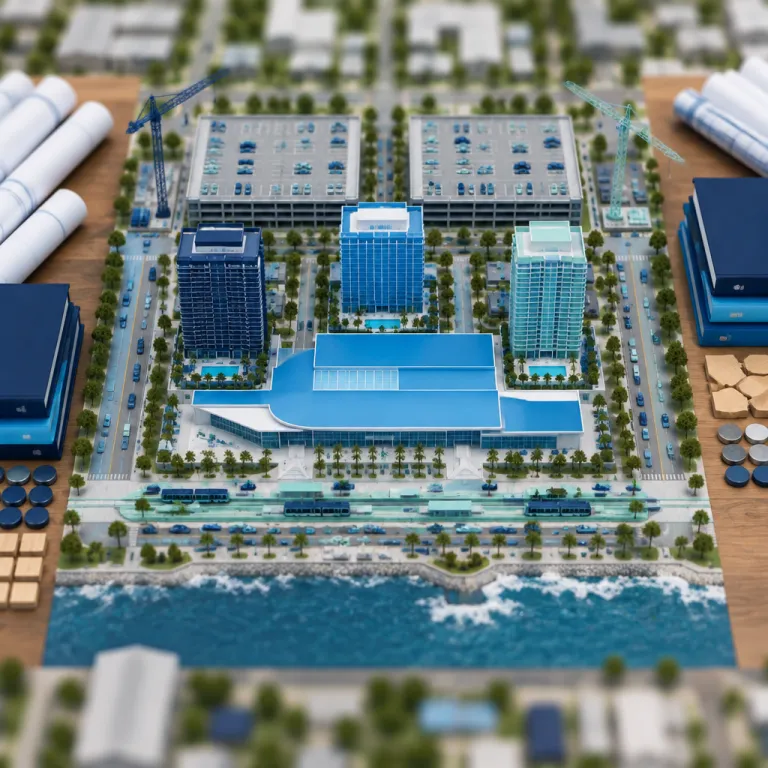
Why convention center hotel investment is structurally a public‑private product
Convention center hotel investment sits in a category that traditional underwriting struggles to price. The asset is physically a center hotel with hundreds of hotel rooms, but economically it behaves like a piece of convention infrastructure whose cash flows depend on civic policy as much as on RevPAR. For a chief financial officer or asset manager, that means the real counterparty is not only the operator but also the city council, the convention and visitors bureau, and the state local authorities that control the events pipeline.
The demand profile of a headquarters hotel attached to a convention center is fundamentally event driven. Base demand hotel segments such as corporate transient and leisure help, yet the real value comes from large events and conventions that generate thousands of room nights in compressed windows and push average daily rate well above the rest of the market. This creates a highly concentrated demand supply pattern where weekday occupancy can spike above 90 percent while shoulder nights and weekends in some downtown markets struggle to reach sustainable market occupancy.
From a capital markets perspective, this volatility is not a market failure ; it is the product design. A convention center hotel investment is built to serve a convention district first and to optimize NOI second, which is why private equity alone rarely accepts the risk without public participation. The supply demand balance is managed not only through pricing and distribution but also through the long term booking calendar of the convention centers, which are usually controlled by public or quasi public entities.
In practice, this means that the underwriting model for a new project will include assumptions about future events that are negotiated years in advance. The city and the financial center stakeholders commit to marketing spend, airlift development, and sometimes minimum event guarantees to provide a stable base of demand. Without those commitments, the project will not clear the required debt service coverage ratios, and the convention center hotel investment simply does not get built.
For hotel investors used to pure private deals, this hybrid nature can feel uncomfortable. Yet once you accept that the convention center and the headquarters hotel function as a single economic unit, the rationale for public subsidy becomes clearer. The public sector captures tax revenues, jobs, and urban regeneration, while the private sector captures hotel adr, occupancy, and long term asset appreciation.
Across multiple hotel markets, the pattern repeats. Cities want a large center hotel to compete for national events, but the gap between development cost and feasible room rates is too wide for private capital to bridge alone. That gap is where state local grants, tax increment financing, and other tools enter the capital stack.
Cincinnati’s $540 million headquarters hotel: anatomy of a 46 percent public stack
The Cincinnati Marriott convention center hotel investment is the clearest recent example of how far cities must go to de risk these projects. The total project cost is reported at 540 million dollars, and roughly 46 percent of that capital stack comes from public sources, which is an extraordinary level of commitment for a single hotel asset. Yet when you unpack the structure, the logic for the city and the state local partners becomes more rational than the headline suggests.
The financing package for this downtown Cincinnati project will include a 50 million dollar state grant, 112 million dollars in tax increment financing bonds, a 50 million dollar city loan, and 37 million dollars in tax credits. Together these elements provide 249 million dollars of public support, which allows the project to secure senior debt and private equity on terms that reflect the real risk profile of an event driven headquarters hotel. Without this public layer, the project will not achieve the leverage and pricing required to make the development feasible in the current interest rate environment.
This center hotel is not a stand alone bet on hotel adr and market occupancy ; it anchors an 828 million dollar convention district revitalization plan. The convention district plan links the expanded convention center, adjacent mixed use projects, and the headquarters hotel into a single urban regeneration strategy that aims to reposition downtown Cincinnati as a competitive meetings and events hub. For the city council and county officials, the investment case is built on incremental hotel tax, restaurant and retail spend, and the long term repositioning of the city as a regional financial center and visitor destination.
From an asset management perspective, the underwriting must integrate the convention center booking pace, the expected number of annual events, and the projected room nights they will generate. The demand hotel profile is heavily skewed toward group and convention segments, which means that the average daily rate during peak events can be significantly higher than the rest of the year. However, the volatility across years and cycles requires conservative assumptions about demand supply dynamics and a clear view of how the convention centers will be marketed over time.
For investors evaluating similar projects, the Cincinnati deal highlights a key lesson. When a project will rely on public partners for nearly half of its capital, governance, reporting, and performance KPIs must be negotiated with the same rigor as franchise agreements and management contracts. This is where insights from specialized asset classes, such as the underwriting frameworks used in wellness oriented hotels as a distinct asset class, can inform how we structure risk sharing and performance metrics for convention center hotel investment.
The Cincinnati case also illustrates how city council decisions on zoning, infrastructure, and incentives directly shape the feasibility of a headquarters hotel. When the public sector is willing to provide land, infrastructure upgrades, and targeted subsidies, the private sector can focus on optimizing hotel rooms mix, F&B programming, and meeting space to maximize NOI. That alignment is essential, because the hotel will operate for decades while political cycles and economic conditions shift around it.
Nashville and Oklahoma City: different markets, same public commitment logic
Nashville and Oklahoma City show that while every convention center hotel investment is local, the structural need for public participation is universal. In Nashville, the Omni headquarters hotel attached to the Music City Center opened with a capital stack that included significant city backed financing and incentives, reflecting the same supply demand gap seen in Cincinnati. Oklahoma City followed a similar path with its Omni convention center hotel, where public funding and guarantees were required to bridge the difference between development cost and feasible room rates in that market.
In both markets, the convention center and the headquarters hotel were conceived as a single project, even if the legal entities and financing structures were separate. The project will typically include not only the hotel rooms and meeting space but also public realm improvements, parking, and sometimes adjacent mixed use components that support the convention district. For city leaders, the objective is to provide enough critical mass so that national associations and corporate events view the city as a credible alternative to larger, more established convention centers.
From the perspective of hotel investors, these deals challenge traditional views on asset heavy versus asset light strategies. Some operators that once preferred pure management or franchise models are now reconsidering selective ownership in strategic locations, as explored in analyses of why certain operators are buying hotels again. In the convention center segment, taking an equity position in a headquarters hotel can provide stronger alignment with the city and the convention center authority, but only if the public sector continues to provide marketing support and event recruitment over many years.
Oklahoma City’s experience is instructive for secondary and tertiary markets such as Sioux City or other mid sized destinations that aspire to grow their events business. The Omni Oklahoma City opened adjacent to the new convention center with a financing structure that blended public and private capital, recognizing that early years occupancy would be volatile until the convention calendar matured. For investors considering similar projects in smaller markets, the lesson is clear ; the demand supply ramp up period can be long, and the city must be prepared to provide sustained support to stabilize market occupancy.
Nashville, by contrast, benefited from a stronger baseline of leisure and corporate demand, which allowed the headquarters hotel to achieve higher adr and more resilient occupancy outside major events. Yet even there, the city’s willingness to invest in the convention center and related infrastructure was crucial to securing the scale of events needed to justify the hotel. Across both cities, the pattern is consistent ; convention center hotel investment requires a level of public commitment that goes beyond tax abatements and into direct participation in the capital stack.
For asset managers overseeing these properties, the challenge is to operate a hotel that serves both private return targets and public policy goals. The hotel will host citywide events, political conventions, and civic gatherings that may not always maximize short term profitability but are essential to the broader convention district strategy. This dual mandate requires a more nuanced approach to budgeting, capital planning, and stakeholder management than in typical hotel markets.
When public support stalls and how asset managers should underwrite the risk
Not every convention center hotel investment reaches financial close, and the common denominator in stalled projects is usually a breakdown in public support. When city council members change, when state local budgets tighten, or when voters push back against perceived subsidies for private hotels, the carefully assembled capital stack can unravel quickly. For investors, the political risk around convention centers is as material as construction cost inflation or interest rate volatility.
Examples across the United States show what happens when the public share of funding is reduced or withdrawn. Projects that assumed a certain level of grants or tax increment financing often face a funding gap that private capital is unwilling to fill, especially in markets where demand hotel fundamentals are still developing. In some cases, developers attempt to resize the project, reducing hotel rooms or meeting space, but that can undermine the very ability of the convention center to attract large events and generate the room nights needed to support debt service.
For asset managers and chief financial officers, the underwriting process must therefore extend beyond traditional hotel metrics such as adr, occupancy, and market occupancy. A robust model for a headquarters hotel should map out the convention center booking pace, the mix of events by size and season, and the expected contribution of each segment to total room nights over multiple years. It should also stress test scenarios where the convention district underperforms, where competing centers open in nearby cities, or where macroeconomic shocks reduce corporate and association travel.
One practical approach is to align the underwriting of convention center hotels with the more rigorous budget season frameworks now emerging in the industry. Resources such as the analysis on how asset managers should adapt after a year of margin compression highlight the need to integrate scenario planning, cost discipline, and capital allocation into annual planning cycles. Applying similar discipline to convention center hotel investment means building multi year scenarios that reflect both optimistic and conservative views of events driven demand.
In secondary markets, including places like Sioux City or other regional hubs, the risk is amplified because the base of transient and corporate demand is thinner. Here, the convention center and the headquarters hotel are often expected to catalyze new demand rather than simply capture existing flows, which makes the demand supply equation more speculative. Investors should insist on clear commitments from city and state local partners regarding marketing budgets, air service development, and long term support for the convention district.
Ultimately, the asset manager’s role in these projects is to operate a property that was partially built for community purpose, not purely for private returns. That means accepting that some events will provide lower adr but high strategic value for the city, while others will be yield managed aggressively to maximize profitability. The most successful convention center hotel investment strategies are those that align these objectives transparently, with governance structures that provide both accountability and flexibility over the life of the asset.
Key figures and benchmarks for convention center hotel investment
- Public funding for the Cincinnati Marriott headquarters hotel represents approximately 249 million dollars out of a 540 million dollar project cost, or about 46 percent of the total capital stack, illustrating the scale of public participation often required in convention center hotel investment (sources : Hotel News Resource, Portman Holdings).
- The broader Cincinnati convention district revitalization plan anchored by this center hotel and the expanded convention center is reported at 828 million dollars, highlighting how a single headquarters hotel can be part of a nearly billion dollar urban regeneration strategy (sources : Portman Holdings, City of Cincinnati communications).
- In many U.S. convention hotel markets, group and convention segments can account for 40 to 60 percent of annual room nights at the headquarters hotel, compared with 20 to 30 percent in typical upper upscale urban hotels, underscoring the event driven nature of demand (based on industry benchmarking from STR and HVS for large convention centers).
- Average daily rate during major citywide events in leading convention markets such as Nashville or San Antonio can run 30 to 70 percent above the annual average adr for the same hotels, while off peak periods may see occupancy drop 10 to 20 percentage points below event weeks (industry data from STR and local CVB reports).
- Public contributions to convention center hotel projects in the United States commonly range from 20 to 50 percent of total development cost, delivered through a mix of grants, tax increment financing, municipal bonds, and infrastructure spending, reflecting the structural gap between feasible room rates and rising construction costs (analyses from HVS Convention, Sports & Entertainment and various city financial reports).